I have been asked by a couple people, "Those Bluebonnets in your yard are gorgeous! How did you grow them?" So I thought I would post a quick "how-to" on growing them.
How to Grow Bluebonnets

With a little patience, Central Texas gardeners can create a patch of
bluebonnets in their own yards. Five species of Lupinus grow in Texas
and all have been designated as the state flower. The most common
species is
Lupinus texensis, the Texas bluebonnet, which starts
flowering in mid-March. The peak blooming period is usually in
mid-April, although the exact date is impossible to predict due to many
environmental factors. Other prominent species include
L. subcarnosus, a species that grows in the sandy soils of South and East Texas and
L. havardii, a tall species found in West Texas, especially prominent in Big Bend National Park.
Although species of this beautiful wildflower are found each spring
across Texas and can be very abundant along Texas roadsides, it may take
several years to establish a good stand of bluebonnets in your yard. Be
patient! Once they are established, your bluebonnets will reseed and
reappear each spring.
When do I plant the seeds?
Plant the seeds in October & November (early October is best).
Lupinus texensis (Texas bluebonnet)
are annual plants; that is, they go from seed to flower to seed in one
year. They germinate in the fall and grow throughout the winter, and
usually bloom around the end of March to the mid-May. Around mid-May,
they form a seedpod, which is green at first but turns yellow and then
brown. Sometime between the yellow and brown form of the seedpod, the
seeds mature. The seedpods pop open, releasing the small, hard seeds.
Planting Tips
Adapted to the rocky, alkaline soils of the Hill Country – and to its frequent droughts – Texas
bluebonnets produce large, hard-coated seeds that may cause them to
have a low germination rate the first year or two. This is nature’s
“insurance” so that, in case of drought, residual seeds are left in the
soil for the following year. As the hard seed coats wear down from
abrasion and decay, with some water the seedlings begin to sprout.
While a hard seed coat is an excellent mechanism for species survival
during unfavorable years, it can frustrate the gardener who wants a
spring display of colorful blooms the first year after planting. Adding
to a gardener’s frustration, not all seedlings that germinate
successfully establish and grow to maturity. But don’t despair. Over the
years, researchers and gardeners have given many tips about propagating
and cultivating bluebonnets, including the following:
Seed Scarification
As noted, bluebonnet seeds have hard seed coats that often delay
germination for a year of more. To increase the germination rate the
first year, growers often scarify seeds. Scarification means scratching
or nicking
the seed coats to simulate natural weathering processes. Once
scarified, most seeds will germinate quickly and should be watered for
several weeks, especially if the weather is dry.
You can use the following methods to scarify seeds:
- physically nick the seeds with a knife (for small quantities)
- rub the seeds with sandpaper
- freeze the seeds overnight, then quickly pour boiling water over the seeds and soak for several hours at room temperature
It is not recommended to scarify bluebonnet seeds that will not be
receiving water during dry periods in the winter and early spring.
Scarifying stimulates all of the seeds to germinate and does not leave
residual seeds for subsequent years in the event of a drought. In
addition, scarification can damage some seeds. It increases the number
of seeds vulnerable to extreme weather conditions and disease causing
organisms. Scarification does increase the number of seeds that
germinate, but will not guarantee a healthy, self-seeding stand of
bluebonnets; many other factors influence the growth and flowering of
bluebonnets once the seeds have germinated. The goal may not be to have a
high rate of initial germination, but rather a productive stand of
flowering Bluebonnets that reseed on their own without the need for
replanting each year.

About Rhizobium
Like most legumes, the roots of bluebonnets work in association with a bacterium called
Rhizobium which improves plant growth and flowering.
Rhizobium
allows nitrogen fixation, (the conversion of atmospheric nitrogen to a
form usable by plants) to take place. Most inoculants, including
Rhizobium, are species-specific, which means that you cannot use any one inoculant for every legume. Although
Rhizobium
is not commonly available through retail sources, some nurseries offer
pre-inoculated seeds. However, if the seeds were not stored properly
after inoculation, the bacteria may not be alive. Be sure to ask about
storage procedures before purchasing inoculated seeds. Inoculants that
are stored alone or coated on seeds should be places in an airtight
container and refrigerated. Inoculants have a maximum storage life of
about six months.
Many soils already have naturally occurring Rhizobium, which makes
finding a source of Rhizobium and applying it unnecessary. One way to
determine whether
Rhizobium inoculation has occurred is to look
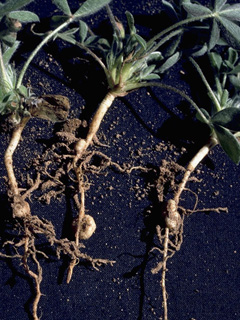
at the roots of an established plant. If there are nodules (small,
rounded lumps containing nitrogen-fixing bacteria) on the roots, the
bluebonnets have been inoculated by the bacteria. If you are not sure if
Rhizobium is present and you can find a source, go ahead and add it.
Rhizobium
can be applied to the seeds before they are planted, or to the soil
after germination has taken place. Applying the bacteria before the
seeds are planted probably is the most efficient and easiest method.
Lightly dampen the seeds so the
Rhizobium powder will stick easily.
For the most successful results, plant seeds in the fall – no later
than mid-November. A fall planting will give seeds the advantage of
early fall rains that induce germination and encourage vigorous root
growth. Bluebonnets winter over as seedlings and are not susceptible to
freezing. The plants have a head start on growth when warm, wet weather
arrives in February and March.
How Much to Plant
The Texas Department of Highways and Public Transportation recommends
a seeding rate of 10 to 12 pounds per acre. At that rate, an ounce
(which contains between 850 and 1,000 seeds) will cover about 200 square
feet.

This is approximately five seeds per square foot. Using that rate,
maximum display probably would be reached the second or third year after
planting. If cost is not a consideration, your area is small or you
want a good display quickly, seed companies recommend using 8 to 10
seeds per square foot. At that rate an ounce will cover approximately
135 square feet, and half a pound covers 1,000 square feet.
An acre will require 20-30 pounds of seeds. (Keep in mind those
seeding rates have been determined on a singlespecies basis and should
be modified if you are planting other species with bluebonnets.)
Choose a sunny, well-drained location with slightly alkaline soil for
Lupinus texensis. South and west-facing slopes will encourage earlier spring growth and flowering.
L. subcarnosus,
which prefers the sandy soils found in areas of East Texas, is also
available commercially in limited amounts and also requires a sunny,
well-drained site.
How to Plant Bluebonnet Seeds
If your site is not weedy and you plan only to interseed bluebonnets
into existing vegetation, the process is relatively easy. Mow the
vegetation to 6-8 inches and rake up the thatch. Try to open up some
bare areas to allow the seeds to make contact with the soil. Prepare
weedy ground by using the techniques outlined in Soil Preparation in
Gardening and Landscaping with Native Plants. For bare ground, plant
seeds on a lightly tilled or slightly roughened soil surface for optimum
seed-soil contact.
One rule applies to all wildflower planting,
good seed-soil contact is essential. Contact with the soil helps retain
moisture around the seeds, which is necessary for germination, and
provides a substrate for seedling growth. Hand broadcasting is the
simplest seeding method and works well. You may dilute the seeds by
mixing them with sand to easily achieve even coverage. Press seeds
firmly into the ground with your hands or walk over the area.
Maintaining Your Bluebonnet Patch
Water your bluebonnets, if possible, using light, well-spaced
waterings. Although bluebonnets require some moisture to germinate and
grow, they do not like saturated soil. If fall or winter rainfall is
low, an occasional watering will help ensure success.
As a general rule, you do not need to fertilize.
L. texensis because it is adapted to alkaline soils that can be low in nutrients, perhaps because of the presence of
Rhizobium.
Fertilizing is not recommended and may encourage leggy and weak plants
with more leaves than flowers. However, if your seedlings do not appear
to be growing vigorously, they may need
Rhizobium, or you may want to fertilize lightly in early spring.
Do not mow until the plants have formed mature seedpods. Bluebonnet
seeds usually mature six to eight weeks after flowering. When mature,
the pods turn yellow or brown and start to dry. By mowing after the
seeds have matured, you will allow the plants to reseed for next year.

 Fresh fruit and herbs are wonderful accompaniments to water, adding
an unexpected zing to an otherwise bland taste. There are dozens of
commercial flavorings on the market, but the majority of them use
chemicals to sweeten and add artificial flavors. We ingest so many
chemicals without meaning to, it seems prudent to avoid them whenever
possible and these days, most of us are avoiding any ingredients we
can't pronounce. (Or we should be) Bottled water is sometimes costly and
all of those plastic bottles headed to landfills aren't environmentally
friendly. Fancy spas and hotels offer exotic flavored waters at a hefty
price, but with just a few items from your garden, you can sip the same
thing as the rich and famous.
Fresh fruit and herbs are wonderful accompaniments to water, adding
an unexpected zing to an otherwise bland taste. There are dozens of
commercial flavorings on the market, but the majority of them use
chemicals to sweeten and add artificial flavors. We ingest so many
chemicals without meaning to, it seems prudent to avoid them whenever
possible and these days, most of us are avoiding any ingredients we
can't pronounce. (Or we should be) Bottled water is sometimes costly and
all of those plastic bottles headed to landfills aren't environmentally
friendly. Fancy spas and hotels offer exotic flavored waters at a hefty
price, but with just a few items from your garden, you can sip the same
thing as the rich and famous.
